Loading…

American Graphic Design Awards 2025
As Humans Fade Student Project
“The value of humanity is fading away as technology takes our place.”
School
University of CincinnatiCategory
Student DesignCreative Credits
DesignerKatie Toepfer
ProfessorReneé Seward Nettle
In the entrant's words
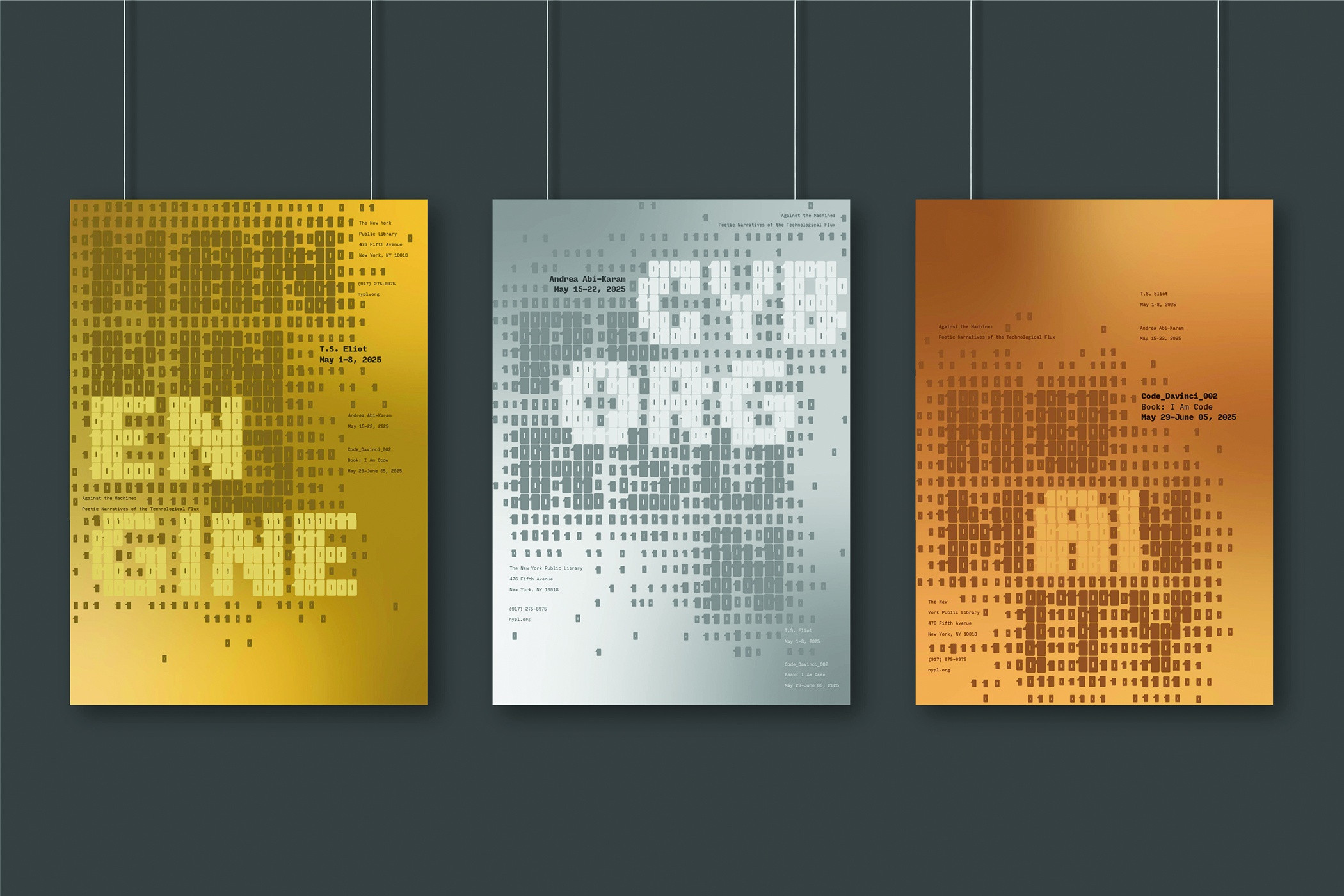
The value of humanity is fading away as technology takes our place. T.S. Eliot, Andrea Abi-Karam, and code-davinci-002 struggle with relying on technology to survive, which results in feeling deprived of their humanity. T.S. Eliot critiques the interwar period, which left humanity fragmented by technology. In The Waste Land, he speaks of a "human engine" or a mechanized individual awaiting activation (Schein, 2009). "Mankind" and "Engine" appear on the posters to convey his idea that the human self is fading away as industrialization replaces the need for human workers. Andrea Abi-Karam wrestles with rejecting dependency on technology and simultaneously wanting to conform to it. This author identifies as a cyborg, explaining the struggle of "conflicted desires to plug in, connect, and also reject the adaptation and remove the wires from within" in Extratransmission (Davis, 2019). "Person" and "Cyborg" are written on the posters to speak to Karam's interpersonal struggle of wanting to identify as a human but needing technology to form an identity. This technological identity overshadows the author's human aspects. code-davinci-002 is the agent that devalues humans. Artificial Intelligence actively replaces the need for human thought and innovation. While this author writes about the value of human creativity, it also voices that those aspects are becoming obsolete because of this new technology in I Am Code (Rich, 2022). "Humanity" and "AI" are written on the posters to capture the current struggle between the two. Method Technology is programmed through code, linear systems, and rules. This is conveyed in my series by utilizing rule-based play, binary code, and a grid system. Typeface Usage: 1s and 0s come from a custom typeface I made. I needed a large type (reflecting technology's commanding presence) that was also blocky (conveying that technology is the building blocks of life). This typeface is used in all three posters. 1. Large words are constructed of this typeface (inversion) 2. Human-related words (Mankind, Person, and Humanity) "fade" in scale and spacing into the background 3. Tech-related words (Engine, Cyborg, and AI) overtake the human-related word, just as technology does with humanity in reality. T.S. Eliot - This poster is gold because this period is often viewed as a "golden era" for technological innovation. Andrea Abi-Karam - This poster is silver because Karam views this new identity as a "silver lining," though identifying as such further deprives the human self. code-davinci-002 - Since AI is becoming more and more "human-like," this poster is Bronze (or copper) because, depending on the angle, this metal reflects hues similar to skin tones.
From the original award submission.
Own this work
ShareCite this page
University of Cincinnati. (2025). As Humans Fade Student Project. GDUSA Design Gallery. https://gallery.gdusa.com/project/as-humans-fade-student-project
AI Design Briefing
Machine-generated analysis of this work. Included with Pro ($19/mo).